
OpenFactory + ServiceNow for Linux Fleet Management
Connect approvals, CMDB updates, runtime alerts, and evidence to the actual Linux build and deploy path.
April 9, 2026
ServiceNow is where many teams already manage change approvals, incident workflow, configuration records, asset visibility, and compliance evidence. But in most environments those workflows still sit one layer above the actual Linux build and deployment machinery. The approval exists in one system. The image build exists in another. The live deploy happens somewhere else. The CMDB update and the runtime evidence trail show up later, often by hand.
OpenFactory closes that gap. ServiceNow stays the workflow and record system. OpenFactory handles the Linux-specific side: recipe-driven image creation, verified builds, live deploy, runtime verification, CVE scanning, rollback, and rebuild actions. The result is not a vague "integration" badge. It is a tighter operational chain between what got approved and what actually changed in the fleet.
ServiceNow Is the Control Plane, Not the Deployment Engine
ServiceNow's own product framing splits this problem across multiple domains: change workflows in ITSM, configuration records and topology visibility in CMDB and ITOM, operational signals in Event Management, response handling in Incident Management, lifecycle visibility in Asset Management, and evidence mapping in GRC. That is important because "fleet management" in enterprise practice is rarely one feature. It is a chain of approvals, records, alerts, ownership, and audit trails around real infrastructure changes.
What ServiceNow generally does not do by itself is build a Linux image, verify that build, deploy it to a live machine, track runtime drift against the expected image, or trigger a rebuild from the same artifact lineage. That is the layer OpenFactory fills.
What OpenFactory Adds to a ServiceNow-Centric Fleet
The integration matters because OpenFactory already owns the artifact and deployment side of the stack. That means ServiceNow can be wired to meaningful events instead of disconnected status updates.
- Verified builds tie approvals and evidence to a specific image lineage.
- Live deploy hooks connect successful host installs to CMDB updates and operational events.
- Runtime verification gives drift and attestation failures something concrete to open incidents against.
- CVE scanning hooks turn advisory findings into event or incident workflows without inventing a second security control plane.
- Rollback and rebuild actions let ServiceNow-triggered remediation map back to the original build system.
That is the difference between "we have ServiceNow" and "our Linux fleet operations are actually tied into ServiceNow." One is organizational. The other is executable.
From Verified Build to Live Deploy
In OpenFactory, the integration can follow the lifecycle of a build instead of stopping at a generic API handoff. A verified build can open a change request. Approval updates can flow back in. A successful live deploy can update CMDB. Runtime drift, attestation failures, and high-severity CVEs can emit events or create incidents. The same build can also push verification and attestation evidence into GRC.
That sequence matters because it keeps the operator from having to manually reconcile four different views of the same change. The build artifact, deployment action, configuration record, and evidence trail stay closer to the same source of truth.
Hook-Level Control Inside CTO GUI
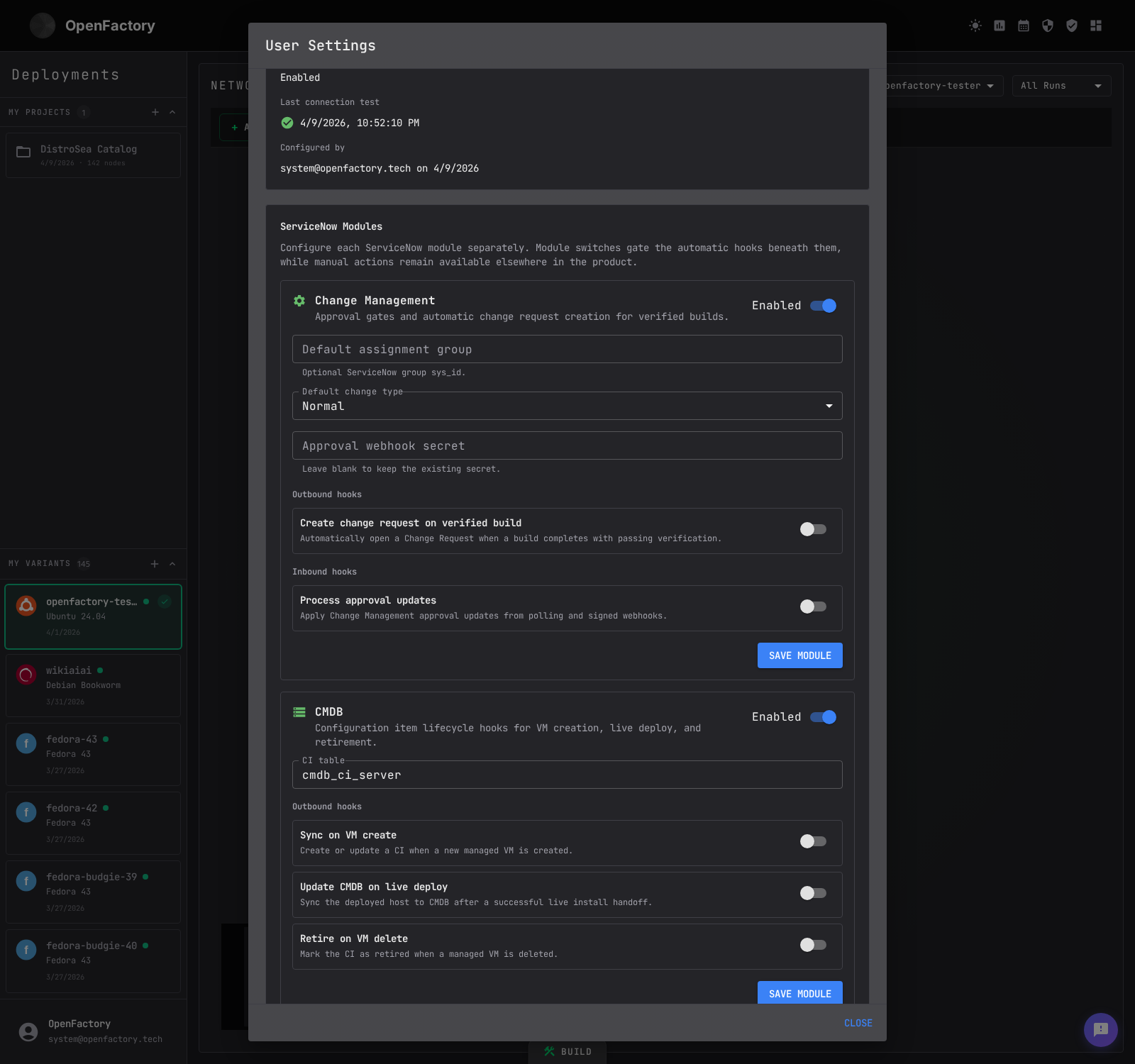
The most important design choice in this integration is granularity. Enterprises do not all want the same automation boundary. Some teams want change creation automated but incident remediation manual. Some want CMDB updates on VM create and live deploy, but not on every runtime event. Some want GRC evidence pushed automatically while keeping the operational event feed narrow.
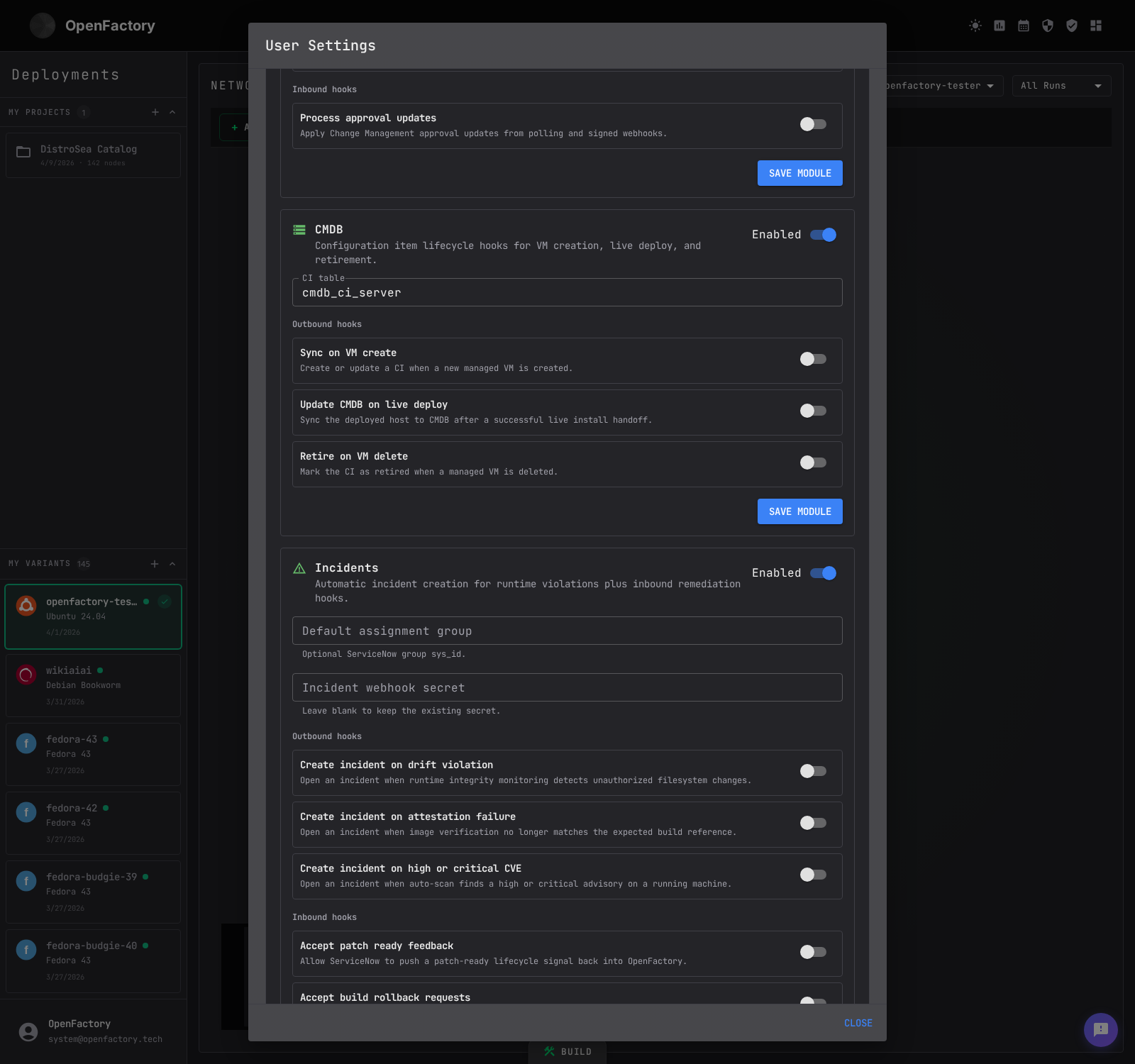
That is why the CTO GUI does not stop at one "Enable ServiceNow" switch. It separates modules for Change Management, CMDB, Incidents, Events, and GRC, and then breaks those modules into hook-level toggles. The operator can enable exactly the workflow they want, including Update CMDB on live deploy, incident creation on drift or attestation failures, signed inbound patch-ready or rollback signals, and automatic evidence push on verified builds.
Just as important, manual actions remain available even when automatic hooks are disabled. The integration is opinionated about wiring, not about governance policy.
Why This Matters for Regulated and Distributed Fleets
For regulated teams, this is about cleaner lineage. If a change was approved, a build was verified, a host was deployed, a configuration record was updated, and evidence was pushed, those steps should line up around the same artifact family. The more of that chain depends on manual swivel-chair work, the weaker the audit story becomes.
For distributed or field-managed fleets, the value is operational. A remote deploy can update CMDB, emit the right event, and keep the incident workflow pointed at the same machine and build context. When a machine drifts or fails attestation later, the response has more structure than a loose ticket with a hostname pasted into it.
That is the real point of the OpenFactory and ServiceNow integration: keep ServiceNow as the workflow and evidence layer, while OpenFactory remains the system that actually builds and changes Linux fleets.
FAQ
Is this a ServiceNow replacement?
No. It is the opposite. The integration assumes ServiceNow is where approvals, incidents, CMDB records, and evidence mapping already live. OpenFactory provides the build, deploy, verification, and remediation side that those workflows need to control.
Can OpenFactory update the CMDB after a successful live deploy?
Yes. The current CTO GUI includes a dedicated hook for updating CMDB on live deploy, separate from VM create and VM retirement behavior.
Do manual actions still work if automatic hooks are off?
Yes. The automatic hooks are configurable so teams can match their governance model. Disabling automatic behavior does not remove the ability to perform manual ServiceNow-related actions elsewhere in the product.
Is this only for heavily regulated teams?
No. Regulated teams get the clearest audit benefit, but the same integration model also helps ordinary infrastructure teams that want cleaner approvals, better CMDB hygiene, and a tighter link between runtime issues and the build that introduced them.